
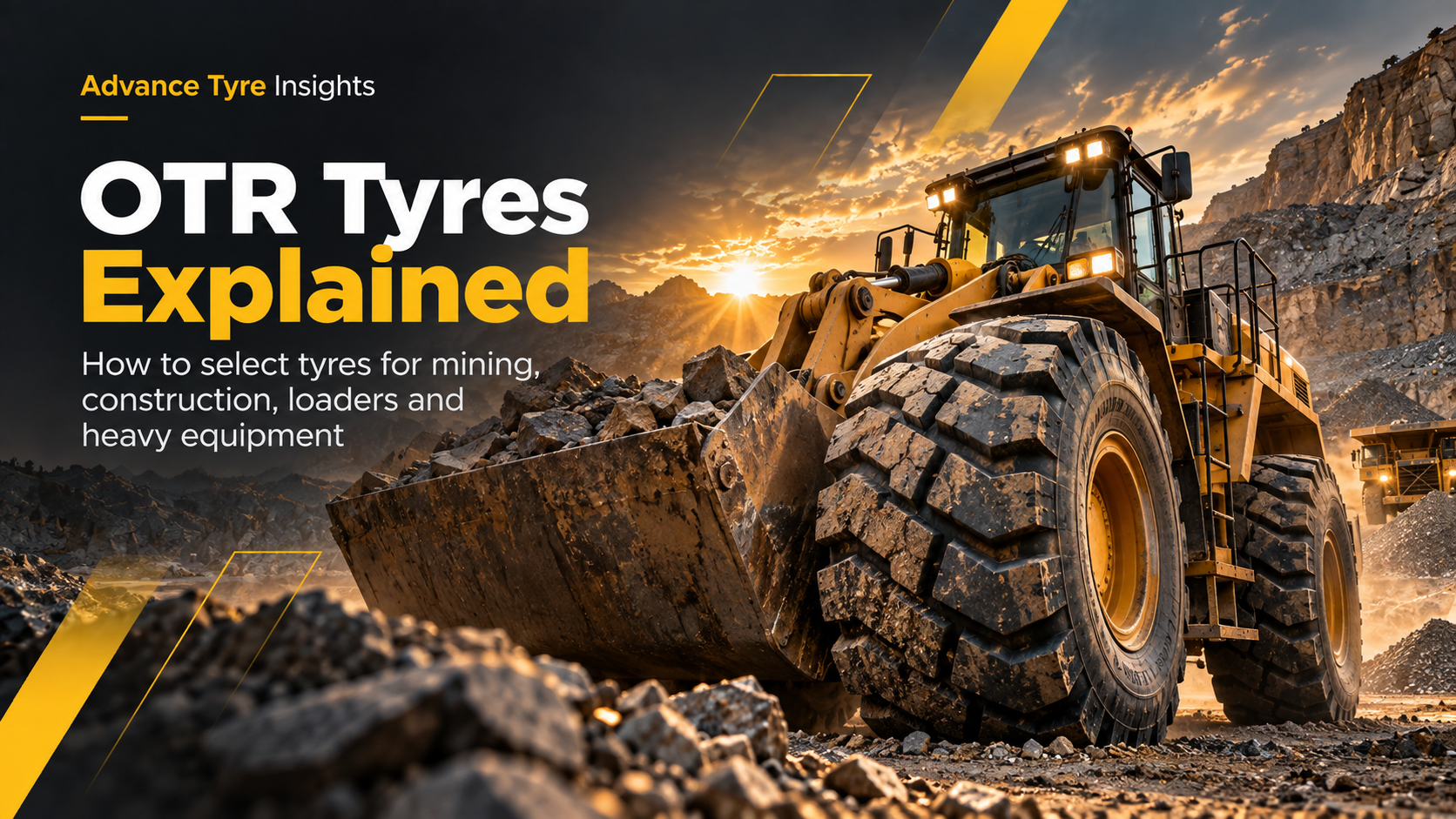

OTR Tyres Explained: How to Select Tyres for Mining, Construction, Loaders and Heavy Equipment
Off-the-road tyres operate in some of the most demanding environments in the tyre industry. Mining sites, quarries, construction projects and earthmoving operations can expose tyres to heavy loads, abrasive surfaces, sharp rock, repeated impact, heat build-up and long operating cycles.
For that reason, choosing an OTR tyre should begin with the machine and the job it performs. Size is essential, but it is only one part of the selection. Buyers should also evaluate equipment type, haul distance, speed, load, terrain, cycle time and the main causes of tyre damage at the site.
What Is an OTR Tyre?
OTR means “off the road.” The term covers tyres developed for equipment that works primarily away from normal highway service. Typical applications include loaders, dozers, graders, earthmovers, mining trucks, quarry equipment and certain forestry or industrial machines.
Advance Tyre’s OTR range is positioned around grip, stability and off-road capability, and its online catalogue includes application groups such as loader and dozer, underground mining and other heavy-equipment uses.
Step 1: Identify the Machine and Its Work
The same tyre should not be selected simply because it fits more than one machine. A wheel loader repeatedly entering a stockpile experiences different forces from a haul truck travelling loaded over a longer route. A dozer can face severe traction and cut conditions, while underground mining equipment may encounter confined spaces, sharp rock and repeated high-load cycles.
Start by recording:
- Machine type and model
- Recommended tyre size and rim
- Maximum axle or wheel load
- Typical operating speed
- Average haul or travel distance
- Number of loaded and unloaded cycles per shift
- Surface condition and gradient
- Primary failure mode of the tyres currently in use
- Step 2: Understand the Terrain
Rocky and abrasive surfaces
Rock and crushed aggregate can create cutting, chipping and tread-wear challenges. In these environments, buyers typically place greater emphasis on robust tread and casing characteristics appropriate to the site.
Soft, muddy or loose ground
Where traction is the dominant challenge, tread design and self-cleaning behaviour become especially important. The tyre must be matched to the machine and terrain rather than selected solely for maximum tread depth.
Mixed construction surfaces
Construction equipment may move between compacted ground, gravel, concrete and temporary access roads. This mixed duty can create a combination of wear, traction and heat-management requirements.
Step 3: Evaluate Load, Speed and Cycle Length
OTR tyre performance is closely linked to how much load is carried, how fast the machine travels and how long it runs during each cycle. A tyre that performs adequately at low speed over short distances may not be appropriate for a faster or longer haul cycle.
This is why technical data and manufacturer recommendations matter. Procurement teams should confirm the tyre’s load capability, inflation requirement, speed conditions, rim specification and stated application before use. Where an operation has unusually severe conditions, the buyer should discuss the duty cycle with the tyre supplier rather than relying on a generic catalogue match.
Step 4: Identify the Site’s Main Tyre Cost Driver
Different sites lose tyre life for different reasons. Before changing products, determine what is actually driving cost:
- Rapid tread wear
- Cuts and punctures
- Impact damage
- Heat-related deterioration
- Sidewall damage
- Irregular wear caused by alignment, loading or operating conditions
- Premature removal due to casing damage
Once the dominant issue is known, tyre selection can focus on the relevant performance characteristic instead of simply choosing a heavier or more aggressive-looking pattern.
Step 5: Consider Total Operating Cost
The lowest purchase price does not automatically produce the lowest tyre cost per operating hour. Mining and construction operators should evaluate total performance across tyre life, including usable tread life, downtime, repair frequency, casing condition and the operational consequences of unscheduled tyre failure.
For a fleet of heavy equipment, a disciplined tyre-management programme can also track hours, distance, pressure, removals and failure causes by machine. That data can help identify whether a product is truly suitable for a specific site.
Questions to Ask an OTR Tyre Supplier
- Which tyre patterns are recommended for this exact machine and application?
- What load, speed and inflation conditions apply?
- Is the pattern intended for loaders, dozers, mining, quarry or another service?
- What sizes are currently available?
- What technical documentation is available for procurement and maintenance teams?
- Can the supplier support multiple equipment categories if the site operates a mixed fleet?
Advance Tyre for OTR Applications
Advance Tyre offers a dedicated Off The Road category alongside Truck, Bus and Radial, Industrial and Agriculture products. The current catalogue contains OTR products for applications including loader and dozer and underground mining, with individual product pages providing technical data by size.
For global buyers, this multi-category range can be useful when procurement extends beyond one equipment type. GTC, the manufacturer behind the Advance brand, states that it has manufacturing bases in China and Vietnam and products sold in more than 130 countries and regions.
Frequently Asked Questions
What does OTR mean in tyres?
OTR means off-the-road. OTR tyres are developed for machinery operating primarily away from standard highway service, including mining, quarrying, construction and earthmoving equipment.
How do I choose an OTR tyre for a loader?
Start with the machine manufacturer’s size and load requirements, then consider the material being handled, surface, travel distance, speed, cycle time and the tyre damage most common at the site. Use a pattern specifically recommended for loader service.
Are mining tyres and construction tyres the same?
They can overlap in some equipment categories, but operating conditions can be very different. Mining may involve heavier loads, sharper rock, longer cycles or more severe heat and impact exposure. The tyre should be selected for the actual machine and duty cycle.
Why is tyre pressure important for OTR equipment?
Inflation pressure affects how the tyre carries load and operates under stress. Pressure should follow the applicable technical specification for the tyre, machine, load and operating conditions.
Where can I find Advance OTR tyres?
The Advance Tyre website provides an OTR category and an all-products catalogue where buyers can filter tyres by category, application and size.
Recommended Internal Links
Off The Road tyres — https://advancetire.com/tyre_category/otr/
All Advance tyres — https://advancetire.com/all-tyres/
Advance Tyre technical knowledge — https://advancetire.com/knowledge/
About Advance Tyre / GTC — https://advancetire.com/about/
Next Step: Explore Advance Tyre’s OTR range and match the tyre pattern and technical specification to your machine, site conditions and operating cycle.


