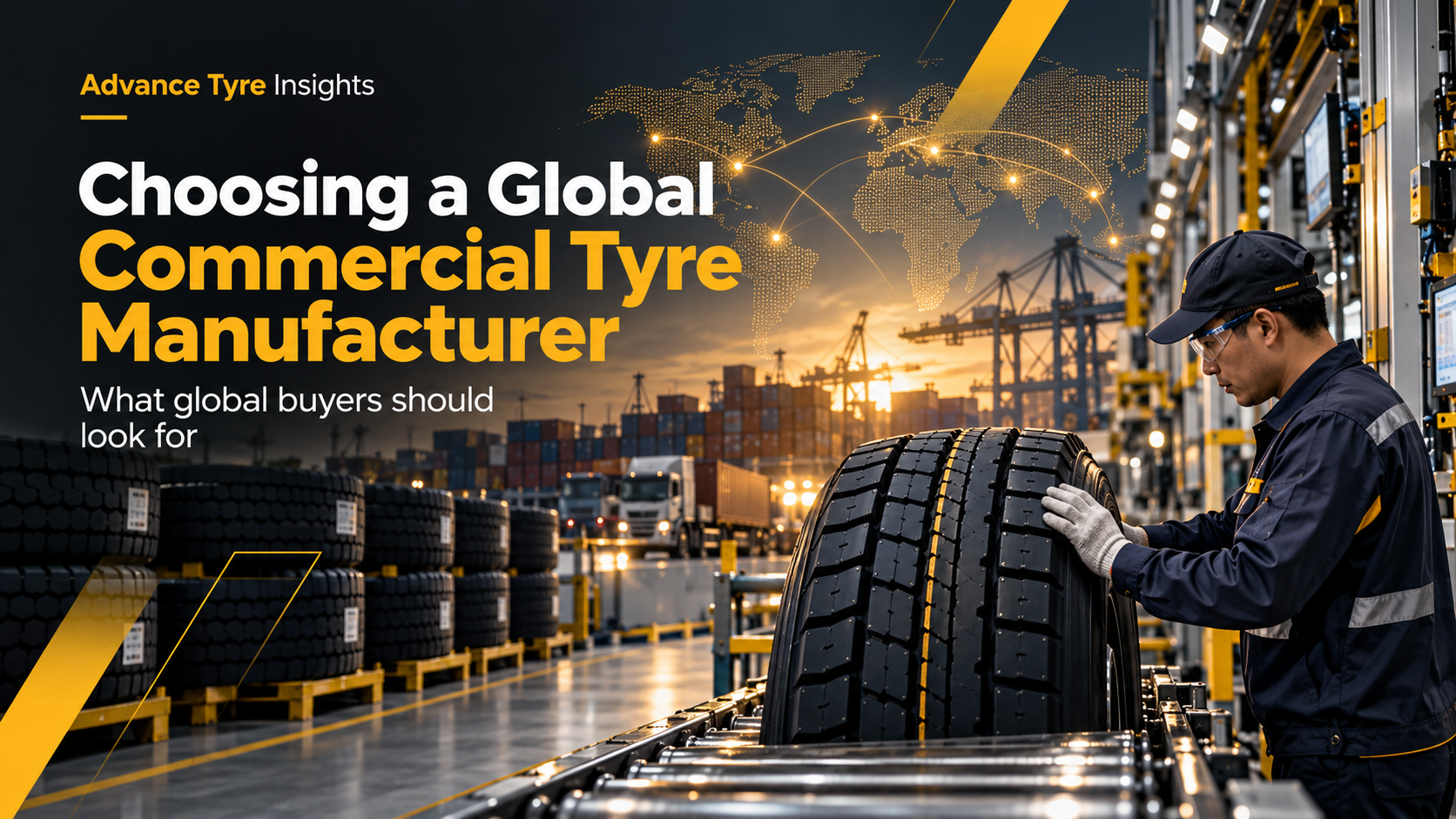
Industrial Tyres Guide: Choosing Tyres for Forklifts, Material Handling and Heavy-Duty Operations
Industrial vehicles often work in environments where tyre demands are concentrated into a relatively small area: warehouses, factories, ports, yards, terminals, construction compounds and material-handling facilities. Frequent turning, repeated loading, abrasive floors, debris and long operating hours can all affect tyre life.
The right industrial tyre therefore depends on more than tyre size. Buyers should consider the vehicle, load, surface, operating hours, travel distance, turning frequency and the main causes of tyre wear or downtime.
What Counts as an Industrial Tyre Application?
Industrial tyre applications can include forklifts, material-handling vehicles, port or terminal equipment, yard machines and other specialised vehicles used to move goods or materials. The exact tyre requirement varies widely between indoor warehouse work and outdoor heavy-duty operations.
Advance Tyre maintains a dedicated Industrial category and describes its industrial tyre development around toughness and durability. Buyers can use the online catalogue to identify products by category, application and size.
1. Identify the Vehicle and Tyre Requirement
Start with the equipment manufacturer’s tyre specification. Record the tyre size, rim, axle load and any construction requirement before comparing products.
For forklifts and other material-handling machines, front and rear tyre loads can differ significantly depending on vehicle design and whether the machine is carrying a load. Procurement should therefore be based on the correct axle and operating condition, not on appearance or nominal size alone.
2. Understand the Operating Surface
Smooth indoor floors
Warehouses and factories may have smooth concrete or coated floors. The tyre must suit frequent turning, acceleration and braking without creating unacceptable wear or instability for the intended operation.
Outdoor yards
Outdoor work can introduce rough concrete, asphalt, gravel, joints, debris and water. The tyre may need greater tolerance for impact and surface irregularity than a tyre used only indoors.
Ports, terminals and heavy industrial sites
Heavy material-handling environments can combine high loads, long shifts, repeated cycles and abrasive surfaces. These conditions should be discussed with the supplier when selecting a tyre pattern and specification.
3. Measure Duty Cycle
Duty cycle describes how hard and how long the equipment works. Important questions include:
- How many hours per shift is the vehicle operating?
- How much time is spent loaded versus unloaded?
- How far does the machine travel per cycle?
- How frequently does it turn or reverse?
- Does the vehicle operate continuously or intermittently?
- Is the operating environment hot, wet, dusty or contaminated with debris?
Two identical forklifts can require different tyre strategies if one performs short indoor pick-and-place cycles while another travels longer distances outdoors with heavy loads.
4. Prioritise the Main Performance Requirement
Industrial operations typically focus on a combination of durability, stability, wear life, traction, resistance to damage and predictable handling. The weighting depends on the job.
A warehouse may prioritise smooth and consistent operation, while an outdoor yard may be more concerned with durability on rough surfaces. A high-utilisation terminal fleet may evaluate tyre cost per operating hour and downtime more closely than the initial purchase price.
5. Check Load and Technical Data
Industrial tyre selection must respect load and equipment specifications. Check the manufacturer’s technical data for the exact size and product. Do not assume that visually similar tyres have the same load capability or are suitable for the same machine.
Where inflation applies, pressure should also be maintained according to the product and equipment requirements. Where another tyre construction is specified, follow the manufacturer’s installation and maintenance guidance.
6. Track Wear and Failure Causes
A maintenance record can make industrial tyre purchasing more objective. Record installation date, operating hours, removals, tread or wear condition and the reason for replacement.
If tyres repeatedly fail from chunking, impact, uneven wear or another pattern, investigate the operating environment and maintenance practices as well as the tyre itself. Floor condition, overloading, aggressive turning and mechanical alignment can all influence tyre life.
7. Choose a Supplier That Understands Industrial Applications
A useful supplier should be able to help narrow products according to equipment, size, load and duty rather than simply offering the nearest available tyre. Technical data, application guidance and product continuity are especially important for fleets that operate many identical machines.
For distributors, a wider commercial portfolio can also matter. A customer operating a warehouse may have trucks, forklifts, yard equipment and other industrial vehicles, creating demand across more than one tyre category.
Advance Tyre Industrial Range
Advance Tyre’s global portfolio includes a dedicated Industrial category alongside TBR, OTR and Agriculture. The company positions its industrial tyres around toughness and durability and provides an online product catalogue for application and size filtering.
GTC, the manufacturer behind the Advance brand, states that its products are sold across more than 130 countries and regions. International buyers should confirm the exact product availability, technical specification and market requirements for their location before ordering.
Frequently Asked Questions
What should I consider when choosing industrial tyres?
Consider the equipment specification, tyre size, axle load, operating surface, working hours, travel distance, turning frequency, environment and the main cause of tyre wear or downtime.
Are forklift tyres the same for indoor and outdoor use?
Not necessarily. Indoor and outdoor conditions can differ in surface roughness, debris, water, travel distance and impact exposure. The tyre should match the actual operating environment and machine specification.
Why should industrial tyre buyers track operating hours?
Operating-hour data helps compare tyre life across vehicles and applications. It can reveal whether a tyre is delivering acceptable cost per hour and whether repeated failures are linked to a particular duty cycle.
Can I choose an industrial tyre by size alone?
No. Size is only one requirement. Load, construction, rim, application and operating conditions must also be confirmed.
Does Advance Tyre manufacture industrial tyres?
Yes. Industrial is one of the four main product categories currently shown on the Advance Tyre global website.
Recommended Internal Links
Industrial tyres — https://advancetire.com/tyre_category/ind/
All Advance tyres — https://advancetire.com/all-tyres/
About Advance Tyre / GTC — https://advancetire.com/about/
Contact Advance Tyre — https://advancetire.com/contact/
Next Step: Explore Advance Tyre’s Industrial range and compare products according to equipment, application, size and operating requirements.